Blog
Fiber Enablement
FiberCo
BSS
Wholesale Monetization

ZIRA Group
Fiber is no longer just being built. It is being tested commercially, operationally, and strategically.
Fiber has moved far beyond the narrow definition of “faster broadband.” It is now the physical layer beneath cloud services, AI workloads, enterprise connectivity, smart cities, and next-generation mobile networks. In Europe, FTTH/B coverage in the EU39 reached 74.6% by September 2024, while take-up reached 53%. Across the OECD, fiber accounted for 44.6% of all fixed broadband subscriptions as of June 2024, up from 41% the year before.
The message is clear: fiber is no longer emerging but is becoming the default architecture of modern connectivity.
Fiber is becoming strategic infrastructure
For years, fiber was discussed as a network upgrade. Today, it is better understood as a strategic national infrastructure. It supports symmetrical speeds, long-distance performance with minimal loss, and the capacity required for 5G backhaul, enterprise-grade services, and the growing demands of cloud and AI. The OECD notes that fiber is essential not only for high-quality fixed networks but also for next-generation mobile networks that rely on its backhaul.
That shift matters because the market is no longer asking, “Should we build fiber?” The real question is, “How do we build fiber in a way that creates durable commercial value?” That is where the fiber market is entering a more demanding phase, one where execution, adoption, and operating models matter as much as coverage.

Coverage is growing faster than adoption
The latest FTTH Council Europe and Capacity Global data shows strong momentum in homes passed, subscribers, and coverage. Yet the same report makes another point that should get more attention: the gap between coverage and adoption remains significant. EU39 take-up is 53%, which means a large share of passed homes are not yet translated into active revenue. In other words, the market’s next challenge is not simply fiber rollout but fiber monetization.
This is a crucial distinction for telecom professionals and investors. Build-out creates potential. Adoption creates return. And between those two, a complex layer of commercial, operational, and partner management work often goes underestimated. Fiber is capital-intensive, long-cycle infrastructure. If the business model is not designed to support speed to market, service flexibility, and wholesale coordination, the network can become an expensive asset with underwhelming yield.
The hidden bottlenecks are operational, not only physical
The report highlights something the industry often says too quietly: fiber deployment is constrained not only by capital but also by labor, coordination, permitting, rights of way, and fragmented processes. That matters because the next wave of fiber growth is increasingly being asked to serve multiple use cases at once: residential, enterprise, mobile, wholesale, and edge connectivity.
This is why fiber business success can no longer be measured only in kilometers built or homes passed. It must also be measured in how quickly a provider can onboard partners, activate services, manage billing, assure service quality, and scale new commercial models without creating operational debt. The market is maturing, and mature markets reward efficiency, orchestration, and repeatability.
The next growth engine: Wholesale fiber and open-access models
One of the clearest trends in the fiber market is the rise of wholesale and open-access models. These models allow infrastructure owners to separate the heavy lift of network investment from the complexity of service monetization, partner onboarding, and lifecycle management. That makes them especially relevant in markets where fiber build-out is accelerating, but the economics require broader ecosystem participation.
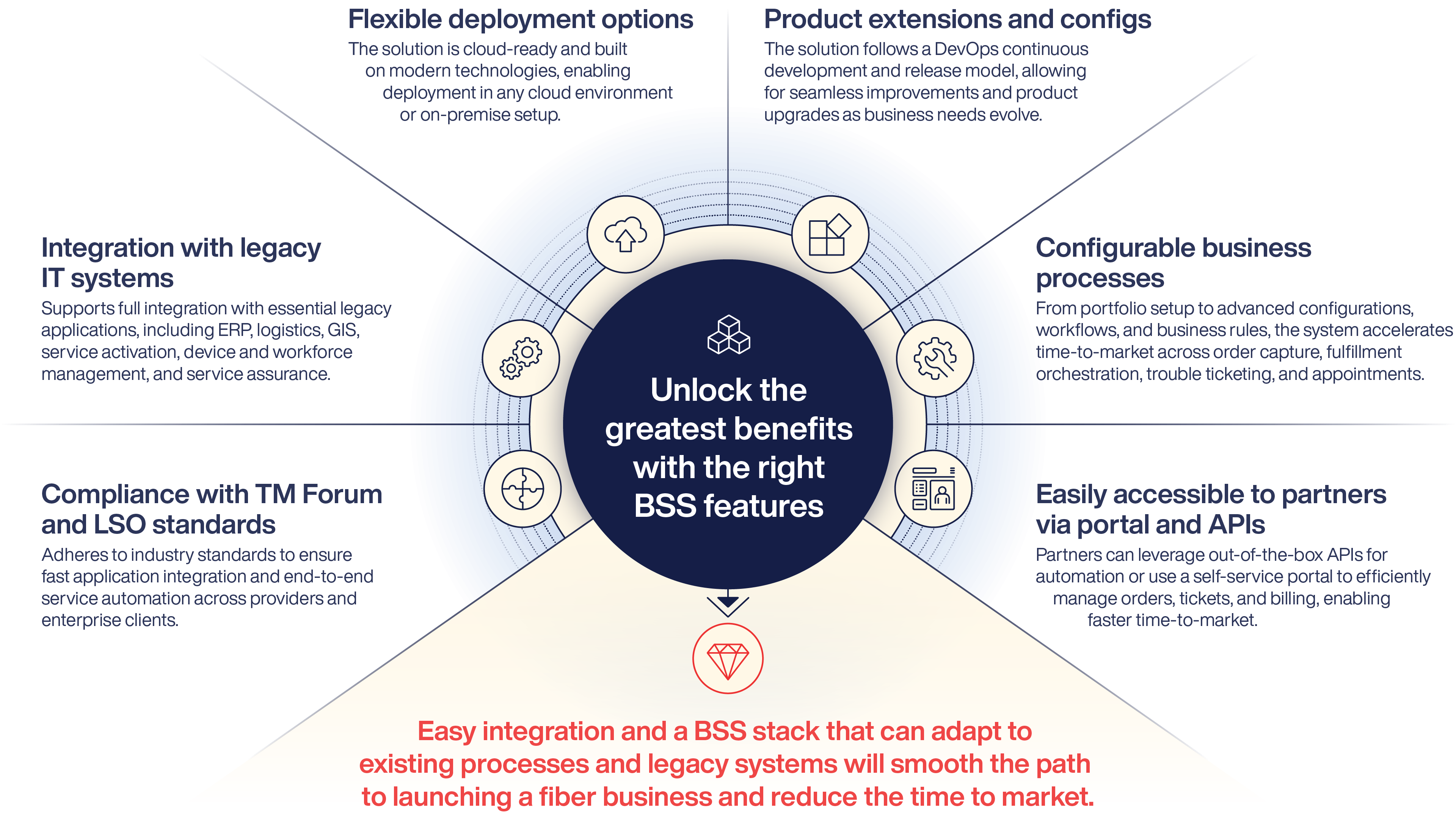
This is where the conversation changes from “network expansion” to “platform business.” Fiber is not only a physical asset; it is a multi-sided commercial environment. Operators need to support retail customers, wholesale partners, business customers, and in some cases other infrastructure players, each with different contracts, pricing, service levels, and fulfillment paths. The more the market moves toward shared infrastructure, the more valuable a flexible business layer becomes.
ZIRA’s perspective: Fiber success depends on business readiness
At ZIRA, we see a consistent pattern across fiber markets globally. Fiber introduces complexity, multi-partner ecosystems, wholesale models, dynamic pricing, service bundling, and high expectations for speed and reliability. Without the right operational foundation, even the most advanced network can struggle to deliver commercial value.
This is why the next phase of fiber leadership will be defined by business readiness.
Operators need the ability to:
- Rapidly onboard partners and launch new services
- Manage complex wholesale and B2B2X models
- Orchestrate end-to-end order-to-cash processes
- Expose capabilities through APIs for ecosystem integration
- Scale operations without increasing friction
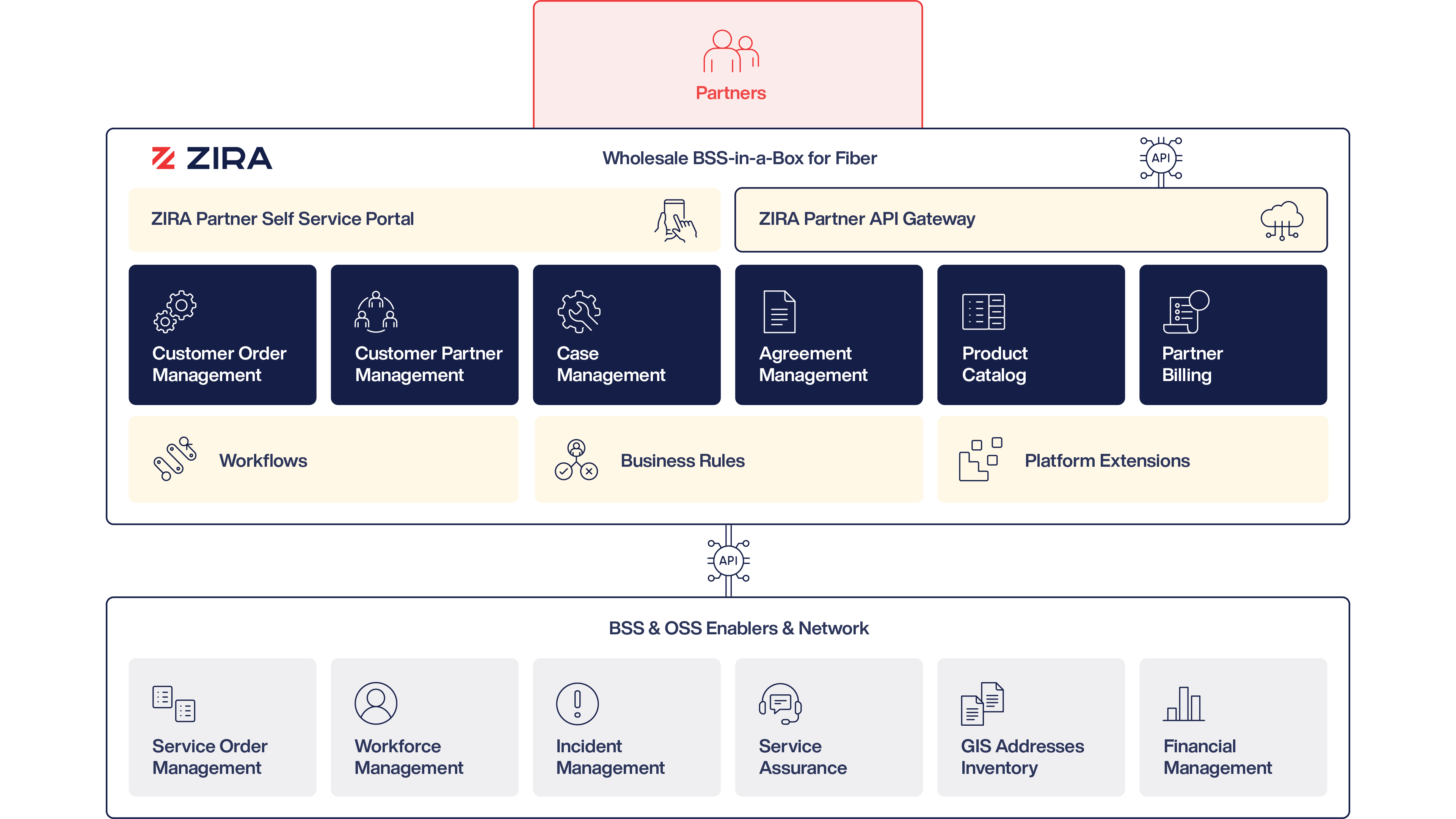
This is where modern Business Support Systems become critical, not as back-office tools, but as the engine that translates fiber capacity into revenue, customer experience, and long-term value. This matters because fiber growth is increasingly multi-dimensional. A provider may need to support wholesale fiber one day, B2B2X models the next, and mixed ownership structures after that. A rigid legacy stack can slow down all of this. A modular BSS approach, by contrast, helps operators stay commercially agile while keeping complexity under control. That is not a product pitch; it is the reality of the market.
What winning fiber operators will do differently
The next phase of fiber leadership will not belong only to those who build fast but also to those who align infrastructure, commercial strategy, and operating model from the start.
They will design networks for more than one use case. They will treat adoption as a strategic KPI, not a secondary outcome. They will invest in wholesale readiness early, not after the network is already under pressure. And they will build digital systems that let them monetize fiber without adding operational friction.
That is where Business Support Systems have become a competitive advantage. Not as back-office plumbing, but as the mechanism that turns fiber capacity into customer value, partner value, and enterprise value.
The real story of the fiber market
The fiber market is not simply expanding. It is evolving. Coverage is increasing, adoption is rising, and fiber is becoming the foundation for AI, mobile, cloud, and digital inclusion. But the winners will not be defined only by where they build. They will be defined by how well they operate. The fiber industry’s next frontier is not just connecting more places. It is building a business model strong enough to make those connections matter.
And that is the real fiber opportunity: not merely to pass homes, but to create a market that can finally keep pace with the infrastructure it is building