Blog
New business models
Automation
Operational efficiency
Telco
TowerCo
FiberCo


Merima Žiko
Commercial Director
Increased agility, drastically shorter development cycles, and a clearer path to migrate from legacy systems are now real outcomes, not just promises. TM Forum’s ODA and the wider ODF have moved from concept to production: operators are running ODA-based deployments, TM Forum has launched component certification, and vendor ecosystems are converging around ODA design principles. For CSPs this means a concrete, standards-driven route to cloud-native, composable BSS/OSS.
It sounds like music to the ears of Communication Service Providers (CSPs), but is it something that is really achievable? Traditionally, building IT systems for communication networks has been fraught with challenges, from slow implementation to systems that do not integrate easily with pre-existing infrastructure. As a result, IT for CSPs comes with the expectation of some level of friction.
However, TM Forum is looking to change that reputation through its Open Digital Architecture (ODA) and Open Digital Framework (ODF) initiatives. They are defining a migration path from legacy IT systems to modular, cloud-native software, making use of the latest technology, including AI and automation, to transform the IT function for CSPs.
We are delighted to say that ZIRA recently signed the Open Digital Architecture (ODA) manifesto. TM Forum highlights the importance of friction-free and streamlined processes to increase agility in CSPs, and ZIRA is fully committed to ODF and building a future based on the ODA model. So what exactly is it, and why should the industry be excited? Merima Žiko, Commercial Director at ZIRA, explains.
What are ODA and ODF? A brief overview
First, let’s look at how ODA and ODF differ and why both are vital to the new vision for the industry.
Open Digital Architecture (ODA) is a practical approach to implementing the principles of TM Forum’s vision for the future of CSP IT. It is a cloud-native blueprint for all players in the industry: Communication Service Providers (CSPs), vendors, and system integrators. Their services can be mapped against the blueprint to allow easy integration and implementation. It uses a single common language, gives a universal model on which all solutions are based, and is at the heart of driving streamlining through standardization.
ODA is no longer just a blueprint; several leading operators and vendors have public “Running on ODA” achievements and case studies showing measurable benefits. Examples include TELUS, the first North American operator awarded “Running on ODA”, large-scale transformations such as NTT’s migration that reported uplifts in operational efficiency, and more recently, stc Group and Verizon’s Running on ODA accreditation. These real-world deployments demonstrate that the architecture scales to major operator environments.
Open Digital Framework (ODF) then builds on it with other key TM Forum assets such as the Maturity Models (AI, Customer Experience Management, etc.), metrics, data depositories, including AI training data, and transformational toolkits that can be used to drive improvements for organizations in the industry. This is a fuller portfolio of resources that ensures the commonality that is essential to not only defining a single approach for building IT services but also implementing it in an effective and consistent way.
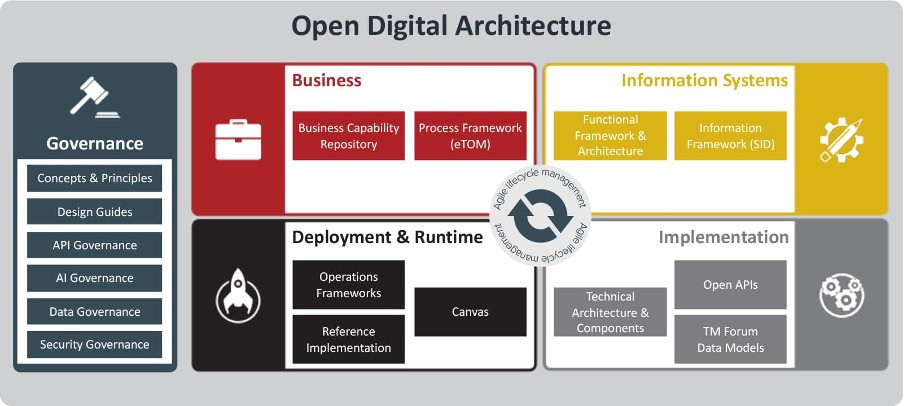
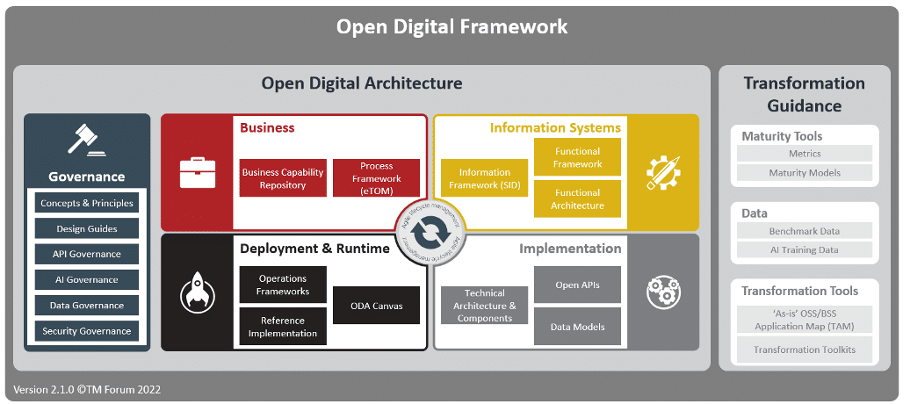
With both the ODA and ODF being driven in close collaboration with dozens of industry players, the blueprint created is informed by practical considerations. Facilitated by TM Forum, it is created by members for members, and this will be key to its success.
How does it work? An alternative to the one-stop shop
Important 2024–2025 developments to note: TM Forum rolled out ODA Component Certification and the ODA Canvas to make “plug-and-play” composability verifiable and repeatable. Component certification reduces integration risk for CSPs and creates a trusted shorthand for vendors who conform to the ODA interfaces and data models. That certification, together with ODA Canvas tooling, helps accelerate safe, low-friction adoption.
The ODF, and specifically the ODA within it, addresses the industry-wide need for easier integration. Building piecemeal systems is a well-known headache for CSPs. One of the biggest drawbacks is the difficulty involved in changing out vendors that no longer fully meet their needs. The challenge of unpicking their solution from their architecture, without disruption, is difficult to navigate and needs to be addressed.
Typically, vendors have tried to address this issue by offering a one-stop shop solution. They cover a very broad range of services and include additional white-labeled or partner solutions within their offering to make it easier for CSPs. Although this has its place, ODA offers an elegant, alternative solution. It provides flexibility and allows CSPs to work with a range of partners to build their own best-in-class digital system. It gives CSPs the convenience of a ‘shopping mall’ of best-in-class modules that can be packaged together through Open APIs to build a complete, agile IT system for CSPs.
ODA-compliant vendors will offer software blocks that can be easily implemented by CSPs to support specific, defined business functions and drive efficiency. They will be standardized, easing integration with existing CSP systems and other partners. It simplifies the marketplace, removing friction, delivering agility, and lowering operational costs.
A positive for industry evolution
Two additional drivers now shaping ODA uptake are AI and data governance. TM Forum’s missions increasingly align ODA with AI-ready data models and MLOps-friendly architectures that enable safe, auditable AI deployments. For CSPs, that means the architecture supports not just microservices and APIs but also the operational practices needed to embed AI and analytics responsibly.
At ZIRA, we are fully committed to the ODA and ODF standards and engaging in the cross-industry collaboration that is needed to realize the vision of a single, universal approach to building communication IT systems. Part of the driver behind this is the wide-ranging benefits that the framework brings to the industry. Firstly, standardization makes compliance navigation significantly easier for both CSPs and vendors. It eases some of the procurement stumbling blocks, again reducing the time to market. Aligning the integration principles with Open API standardization was therefore one of our top priorities while designing our products at ZIRA.
Beyond compliance, the nature of the framework makes it ideally positioned to drive innovation. Usually, the main risk of a framework is that it can create a barrier to adoption when other innovative solutions are developed that do not easily fit into the existing scope. However, as ODA is industry-driven, with plans for continuous evolution, it helps to bring innovative and niche offerings into the mainstream much more quickly and allows CSPs to reap the benefits on an accelerated time scale.
Finally, it introduces much-needed transparency across the industry. By developing standards in line with exactly what CSPs require, vendors are given unprecedented insight into exactly what their customers need. This will enable vendors to develop tailored and hone existing solutions to become better partners for their CSP customers.
ODA adoption is accelerating, but industry-wide standardization is incremental. As larger CSPs publish running cases and TM Forum matures certification and benchmark programs, ODA is moving from a “promising blueprint” to a default architecture for agile operators. Expect adoption to grow as certified components and proven migration roadmaps reduce implementation risk.

Conclusion:
The next steps for vendors and CSPs alike are to take the foundation of ODA and build on it. This involves broadening out the modules on the architecture to encompass more areas that can offer benefits to CSPs. It is also demonstrating the value of the ODA to drive wider adoption across the industry. In our next blog, we will look at exactly how ZIRA is embracing the ODA principles, how CSPs can migrate to run on an ODA, and the tangible benefits it is driving. However, looking at the potential ODA and ODF have to transform the industry, it is clear that this initiative will act as a catalyst. Not only to drive innovation but it will make the vision for increased agility, a reduction in the development and procurement cycles, and low-friction migration from legacy systems a reality for both CSPs and the vendors that serve them.
Looking to find out more about ODA at ZIRA today? Get in touch