Blog
TM Forum
Artificial Intelligence (AI)
Wholesale Monetization
Open API
ODA
Fiber Enablement
BSS
Operational efficiency


Željka Senji
Product Manager
Ordering and activating broadband have become increasingly digital. When something goes wrong, however, the process can still depend on manual checks, partner portals, and conversations between different teams.
This is especially visible in wholesale broadband, where the company that is serving the customer is often different from the company operating the access network. The ServCo owns the customer relationship and the service promise. The NetCo provides the wholesale access service and has the network-side information needed to diagnose and resolve faults.
So, when a customer says, “My internet is down,” resolving the problem can involve multiple products, systems, organizations, and commercial boundaries.
The TM Forum Catalyst Wholesale broadband as a service: The future of service assurance–Phase III tackled this difficult stage of the wholesale broadband lifecycle. Building on earlier phases for product modeling, ordering, and provisioning, Phase III looked at what happens when a service needs to be assured: fault intake, testing, root-cause analysis, cross-company ticketing, appointments, and customer updates.
For ZIRA, the project demonstrated how standard-based APIs, product context, workflow orchestration, and AI can connect these capabilities and move wholesale assurance closer to self-service.

Wholesale broadband as a service: The future of service assurance - Phase III
Standardized, automated, digitized wholesale broadband service assurance interactions between network and service providers
Follow projectThe problem is bigger than a ticket
From the customer's perspective, the situation is simple: the internet is not working.
Behind that simple statement, the ServCo may need to identify the affected product, run diagnostics, determine whether the problem sits within its own domain or the wholesale network, raise a ticket with the NetCo, and keep the customer informed while the issue is being resolved.
In a traditional setup, much of this depends on manual work. Agents move between systems, copy information into tickets, wait for responses, and translate technical updates into something the customer can understand.
The issue is not necessarily a lack of tools but the gap between them.
The ServCo and NetCo have different responsibilities and different views of the same service. Wholesale assurance needs to connect those views without making the customer deal with the complexity behind them.
Connecting the ServCo and NetCo
This is where TM Forum Open APIs and Open Digital Architecture (ODA) components come in.
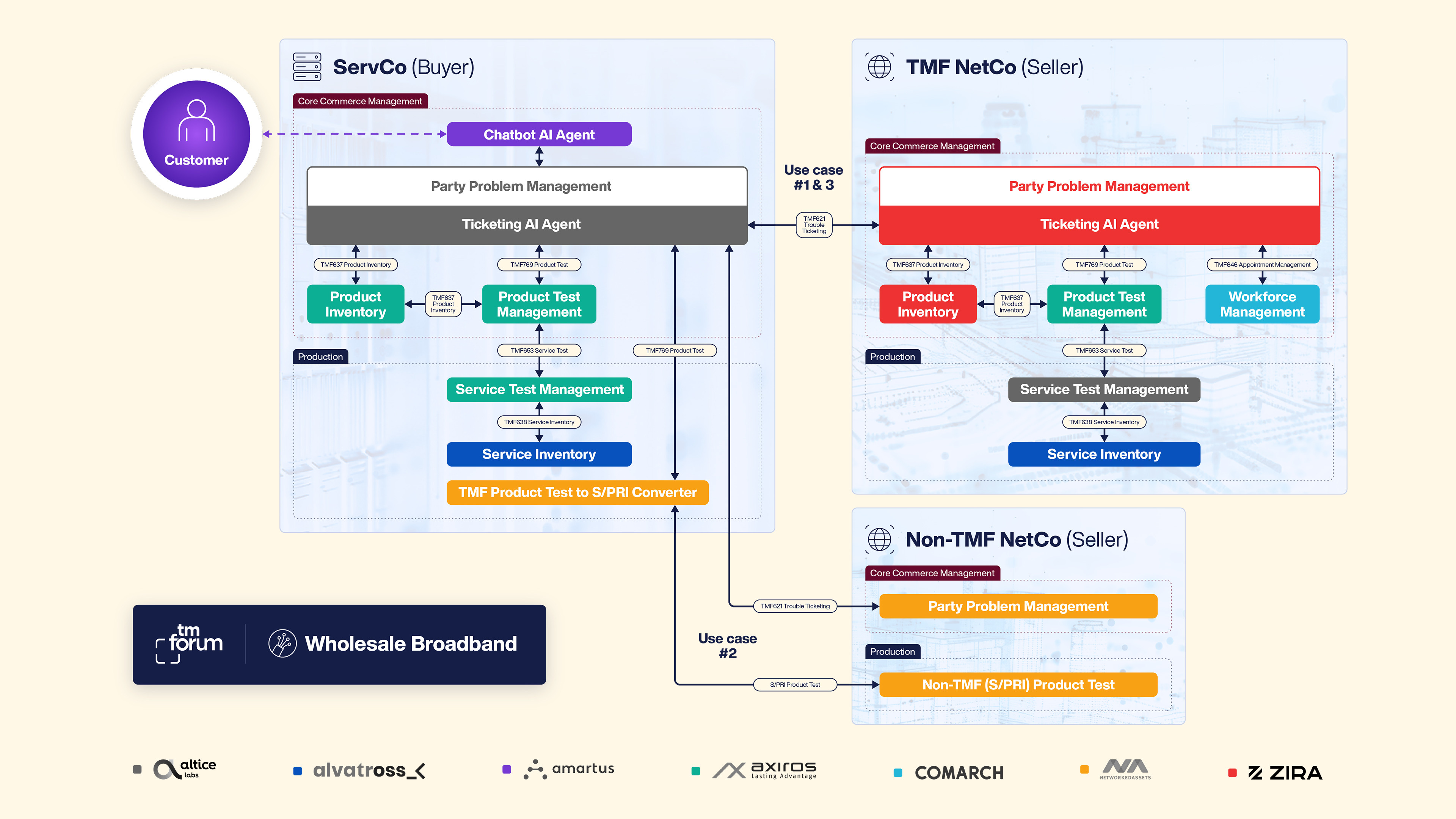
The Catalyst brought together capabilities including TMF621 Trouble Ticket Management, TMF637 Product Inventory Management, TMF638 Service Inventory Management, TMF769 Product Test, TMF653 Service Test, and TMF646 Appointment Management.
Together, they provide a common way for different systems and organizations to participate in the same assurance process.
The goal is not to make every provider use the same systems but to allow existing systems to communicate through consistent interfaces.
At the wholesale boundary, TMF621 provides a structured way to create and manage tickets and receive lifecycle updates. Instead of relying on portals, emails, or manual status checks, the ServCo can receive updates as the NetCo accepts the case, identifies the cause, schedules an intervention, or resolves the fault.
The Catalyst also considered markets where standards-based integration is still being introduced, including a bridge between TM Forum APIs and S/PRI for environments using national or legacy interfaces.
What the self-service assurance looks like
In an assisted support model, the customer contacts an agent, and the agent becomes the link between the different systems and organizations involved.
In a self-service model, the support channel can orchestrate those capabilities directly.
A customer reports a problem through a ServCo app or chatbot. The customer's identity and product are already available, so the system can start with the relevant context. It runs the tests available to the ServCo and, if the evidence points to the wholesale domain, creates a structured ticket for the NetCo.
The NetCo validates the request, runs the appropriate diagnostics, and returns the result through standardized events.
The customer still interacts with the ServCo. What changes is everything happening behind that interaction.
Human support remains important for exceptions and complex cases. But people no longer need to manually connect every step of the standard assurance journey.
A simple example: No internet at home
The Catalyst demonstrated this through a broadband fault scenario involving an Optical Network Terminal (ONT) power failure.
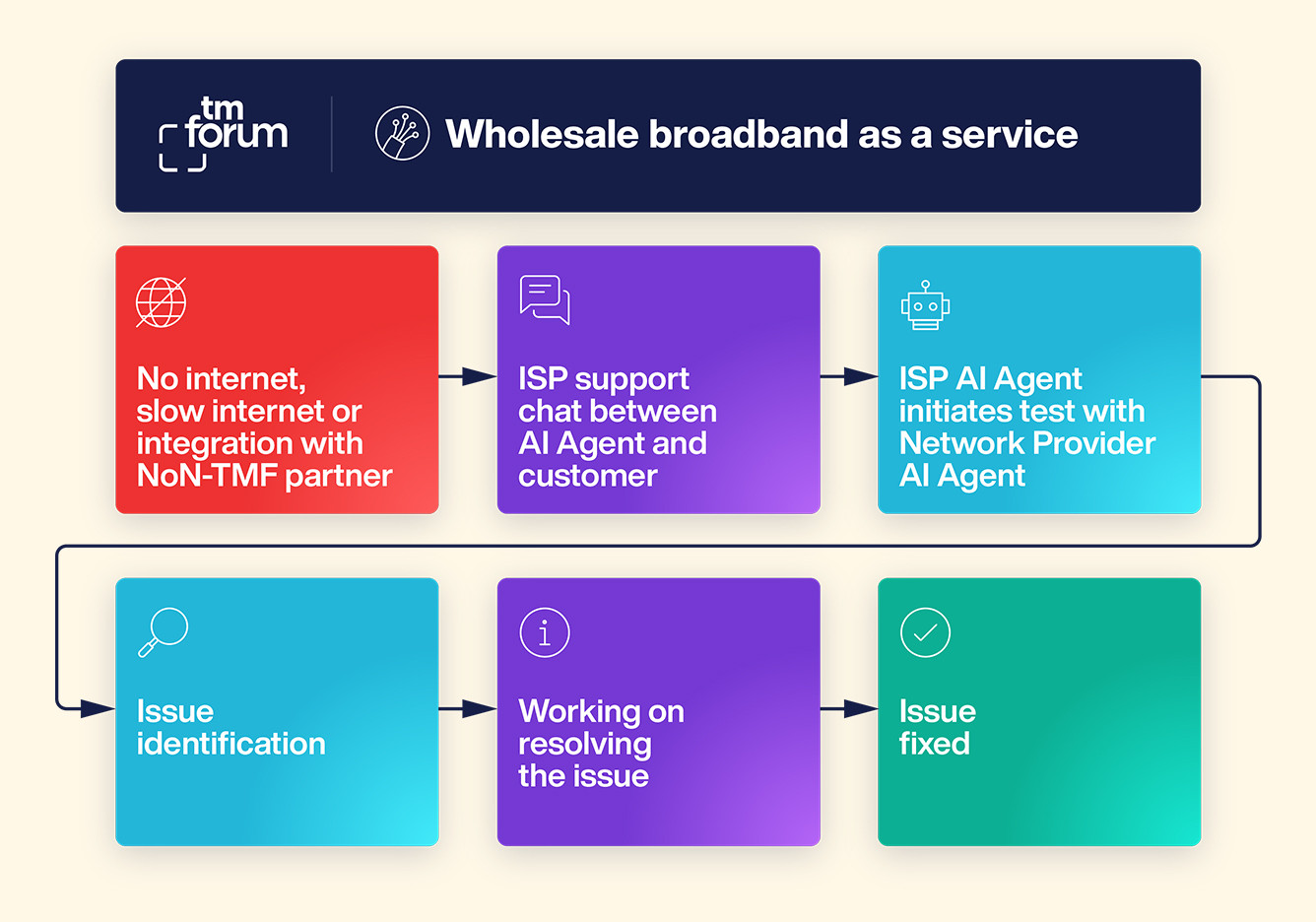
The journey starts with a customer reporting that the internet is unavailable. The ServCo identifies the relevant broadband product and runs the available tests. If the results indicate that the problem is likely within the wholesale access domain, a related NetCo ticket is created through TMF621 with the relevant product, service, and device information.
On the NetCo side, ZIRA validates the request against the partner and product context before the diagnostic process continues.
The workflow then coordinates the relevant tests. In the demonstrated GPON scenario, these can include ONT status, last-down cause, optical power availability, and OLT port status. A dying gasp signal, for example, can indicate that an ONT lost power.
Looking at these results together can point to the cause. If the ONT is offline, the OLT port is healthy, neighboring services are unaffected, and the last-down cause indicates loss of power, the evidence points towards a customer-side power or ONT issue rather than a wider network problem.
The customer, however, does not need to see any of this technical information.
That is where AI can help.
Where AI adds value to assurance
AI is not replacing the APIs, inventory, or assurance workflows. It works on top of them.
Network diagnostics can produce a large amount of technical information. AI can help correlate those results, identify what matters for the decision, and translate it for different audiences.
An operations team may need detailed diagnostic evidence. A ServCo agent may need the likely fault domain and recommended next step. A customer needs a clear explanation and something they can act on.
The value comes from combining AI with reliable product data, structured test results, and a controlled workflow. The standards provide the structure for exchanging information; AI helps interpret and communicate it.
Why product context and workflow matter
For ZIRA, assurance starts with the product, not just the alarm or ticket.
Knowing which product the partner bought, which product instance serves the customer, and which services and network resources support it provides the context needed to decide what should happen next.
That same context can determine which tests are relevant, which SLA rules apply, and which resolution paths are available.
Workflow then connects the steps: validate the request, check for duplicates or known outages, run the relevant tests, evaluate the results, decide on the next action, and keep the ServCo updated.
This combination is what makes automation practical. Product context provides the meaning. Workflow provides the process. AI helps interpret the information along the way.
ZIRA's role in the Catalyst
Within the Catalyst, ZIRA represented the NetCo domain and provided the BSS foundation for the demonstrated assurance flow.
ZIRA contributed to NetCo problem management and ticketing, product and partner context, and AI-supported workflow orchestration. It also demonstrated how these capabilities can be exposed through standard APIs so that multiple ServCos can interact with the NetCo through a common assurance model rather than separate partner-specific processes.
The project brought together operators and technology providers across the wholesale broadband ecosystem, with different participants contributing customer interaction, problem management, testing, inventory, workforce management, and interoperability capabilities. ZIRA's contribution focused on the NetCo side of the assurance journey.
From fault handling to a reusable assurance capability
The scenarios demonstrated in the Catalyst focus on individual customer problems, but the same foundation can support more proactive assurance.
Once product, service, test, and problem data are connected through standardized, event-driven interfaces, a NetCo can identify network events, assess their impact, determine which products and ServCos are affected, and provide updates before customers start calling.
The same model can support SLA monitoring, predictive maintenance, and automated remediation.
For ZIRA, that is the broader value of Catalyst Phase III: showing how Open APIs, product context, workflow, and AI can work together to make a complex wholesale process easier to operate and easier for the customer to experience.
The customer sees one provider; the systems behind the service do not have to look like one.