Blog
Fiber Enablement
FiberCo
BSS
Order Management

ZIRA Group
Opening a broadband network to wholesale partners can create new revenue opportunities.
However, the ability to deliver connectivity and the ability to run a wholesale business are two very different things. A fiber network can be built, tested, and technically ready for service. Yet, when a retail service provider wants to start selling connectivity over that network, a different set of questions emerges.
What can the partner sell? Where is the service available? How does it place an order? Who is responsible for fulfillment? When does billing begin, and how are charges reconciled?
None of these questions are fundamentally about network capacity. They are all about business behind the network. And for retail broadband operators moving into wholesale, that’s where some of the most important decisions begin.
Wholesale changes more than who you sell to
In traditional retail models, the operator controls most of the customer relationships. It defines the packages, accepts orders, activates services, manages subscribers, and handles billing.
Wholesale introduces another business into that relationship. The network owner provides connectivity to retail service providers (RSPs), which build their own retail propositions and serve their own subscribers. The network owner must now support multiple commercial relationships, partner-specific agreements, different ordering channels, and shared operational responsibilities. We can imagine that as straightforward as activating a broadband connection.
In retail, the operator generally manages the process on behalf of its subscriber. In wholesale, an RSP may initiate the order through its own systems, using a product governed by a specific agreement. The network owner must validate eligibility, coordinate fulfilment, communicate the progress, and apply the appropriate charging rules.
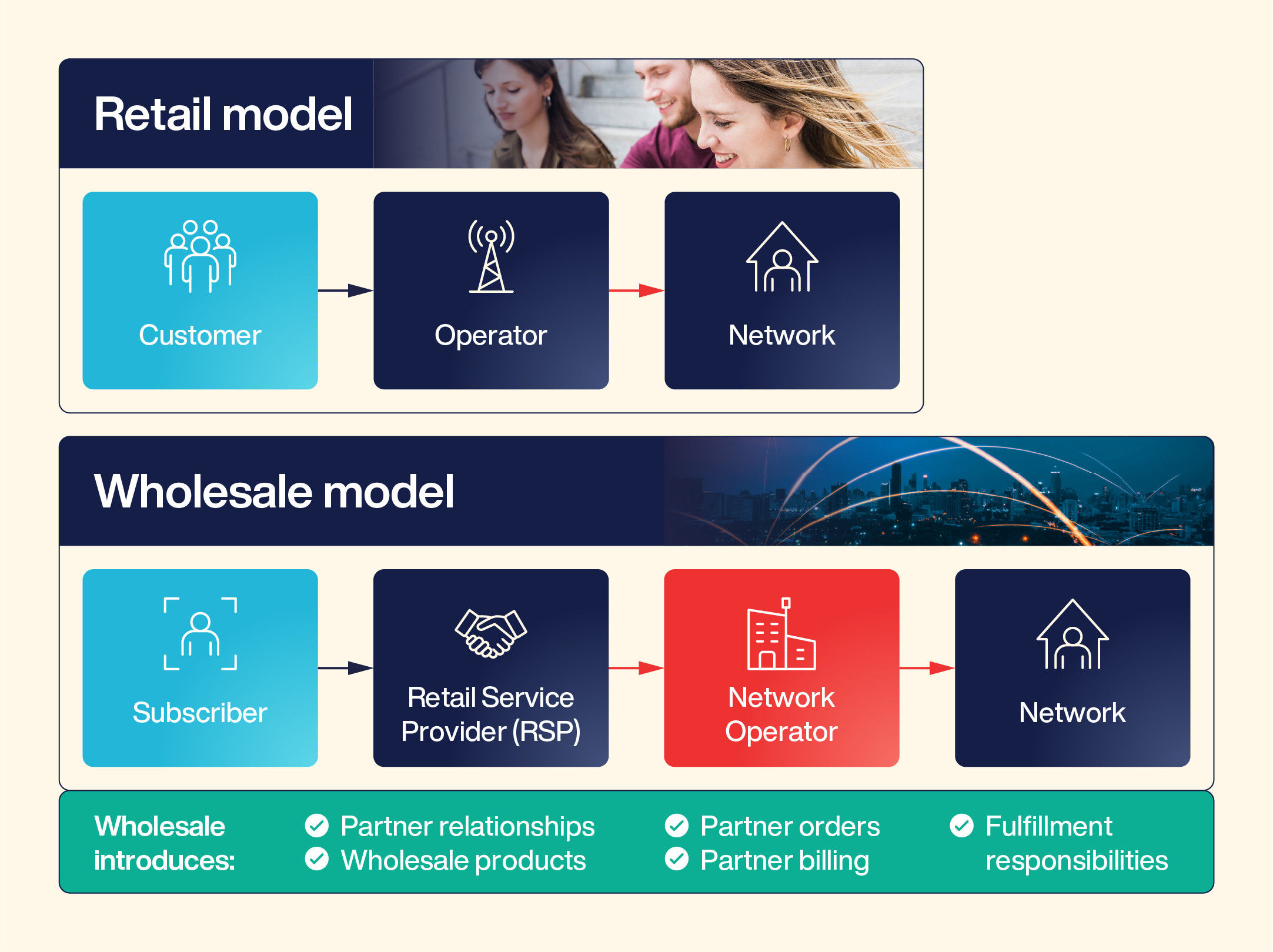
We need to stop looking at wholesale as another sales channel and start seeing it as it is, another operational model. And this distinction is really important when deciding whether existing systems are ready to support it.
The real challenge is keeping commercial commitments connected
Every wholesale service moves through a series of commitments. An agreement defines what a partner is allowed to purchase. The product catalogue translates that agreement into available services and conditions. The ordering process captures the request. Fulfilment systems coordinate delivery. Billing translates the delivered service into a commercial charge. Each step depends on the information established earlier.
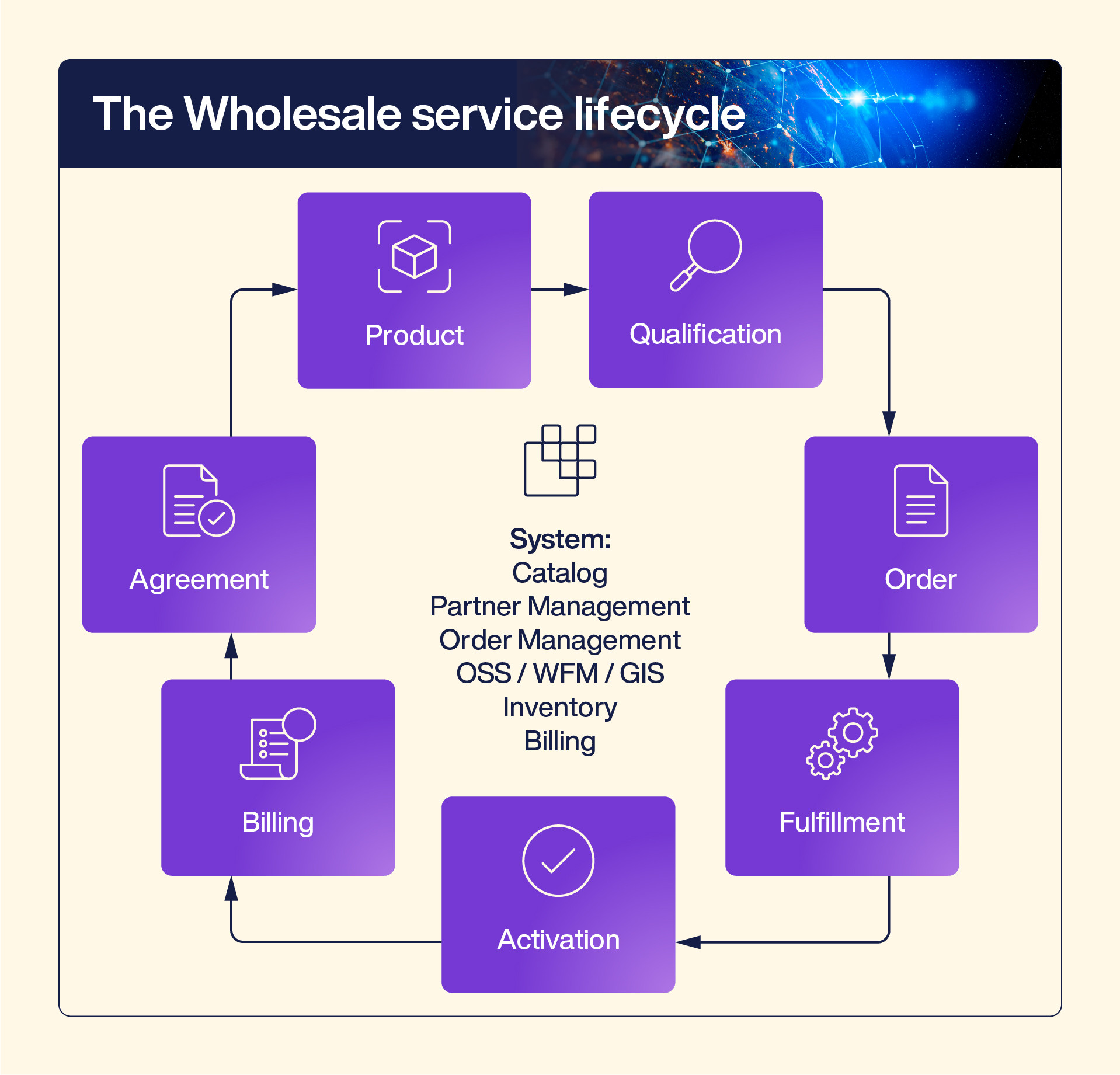
When those connections work, the operator has a consistent basis for managing the service from the initial commercial agreement to invoicing, and when they don't, complexity becomes harder to control.
E.g., a product may be available in the catalogue but not eligible under a particular partner agreement. An order may progress through fulfillment without a consistent status being visible to the RSP. A service activation date may not be reflected correctly in the billing process.
These are not inevitable problems in wholesale. They are just examples of the operational and commercial risks that arise when information and responsibilities are disconnected. And, even worse, their consequences go beyond IT.
Manual intervention adds operational effort. Order uncertainty complicates the partner experience. Inconsistent service and billing records can generate disputes and reconciliation of work. As the number of partners, products, and transactions grows, the cost of managing those exceptions can become increasingly important. So now the question isn't whether your systems can process a wholesale order. It's whether they can consistently manage everything that order commits your business to deliver.
Why partner experience depends on what happens behind the portal
If you’re an RSP, doing business with a network owner should be straightforward. You need to know where services are available, what you can purchase, how to submit orders, and what is happening with those orders.
Basically, self-service portals can provide that experience, as well as APIs, which can allow partners to integrate directly from their own environments. However, neither solves the underlying challenge on its own. A portal is only as useful as the product, eligibility, and order information behind it. An API can automate an exchange between systems, but it cannot compensate for inconsistent business rules or unclear operational responsibilities.
The real objective here is to make the wholesale relationship work reliably across business boundaries. That means maintaining consistency between partner agreements, product information, order validation, service fulfillment, and billing. It also means ensuring that the relevant BSS and OSS environments can coordinate activities without requiring every partner interaction to become a custom project.
This is why interoperability matters
TM Forum's work on standardized wholesale broadband product models and APIs reflects the industry's effort to establish more consistent ways for wholesale buyers and sellers to exchange commercial and operational information. For network owners, the goal is practical: make it easier for partners to consume wholesale services without multiplying integration complexity every time the ecosystem expands.
Does going wholesale mean building a new BSS?
Well, not necessarily.
An operator entering wholesale may already have systems capable of supporting parts of the new business model. The decision is only whether those systems can accommodate wholesale-specific requirements, without creating disproportionate complexity.
Extending the retail BSS may be appropriate where the architecture can support partner agreements, differentiated products, B2B ordering, and wholesale billing.
A dedicated wholesale environment may make more sense when the commercial processes, partner requirements, and operational responsibilities are sufficiently different.
A modular approach can also allow operators to introduce selected capabilities while retaining existing systems. Each option comes with trade-offs in integration effort, implementation cost, operational separation, and future flexibility. The right architecture is not necessarily the one with the most functionality or the greatest degree of separation. It's the one that supports the commercial model the operator intends to run.
That decision should begin with a clear understanding of the wholesale business, not a predetermined technology preference.
Virgin Media Ireland:
Building the business systems behind wholesale fiber
Virgin Media Ireland (VMIE) faced this challenge as it moved from coaxial infrastructure toward fiber and prepared to open its network to wholesale partners. The company was undertaking a major network transformation; however, upgrading the network was only part of the work. VMIE also needed an IT environment capable of supporting different requirements for its retail and wholesale fiber businesses. They chose to establish a dedicated wholesale IT stack.
That decision had to fit within the realities of a capital-intensive infrastructure program, including demanding implementation timelines and the need for a cost-effective solution.
ZIRA implemented its Wholesale BSS-in-a-Box for Fiber to support VMIE’s B2B2X wholesale operations.
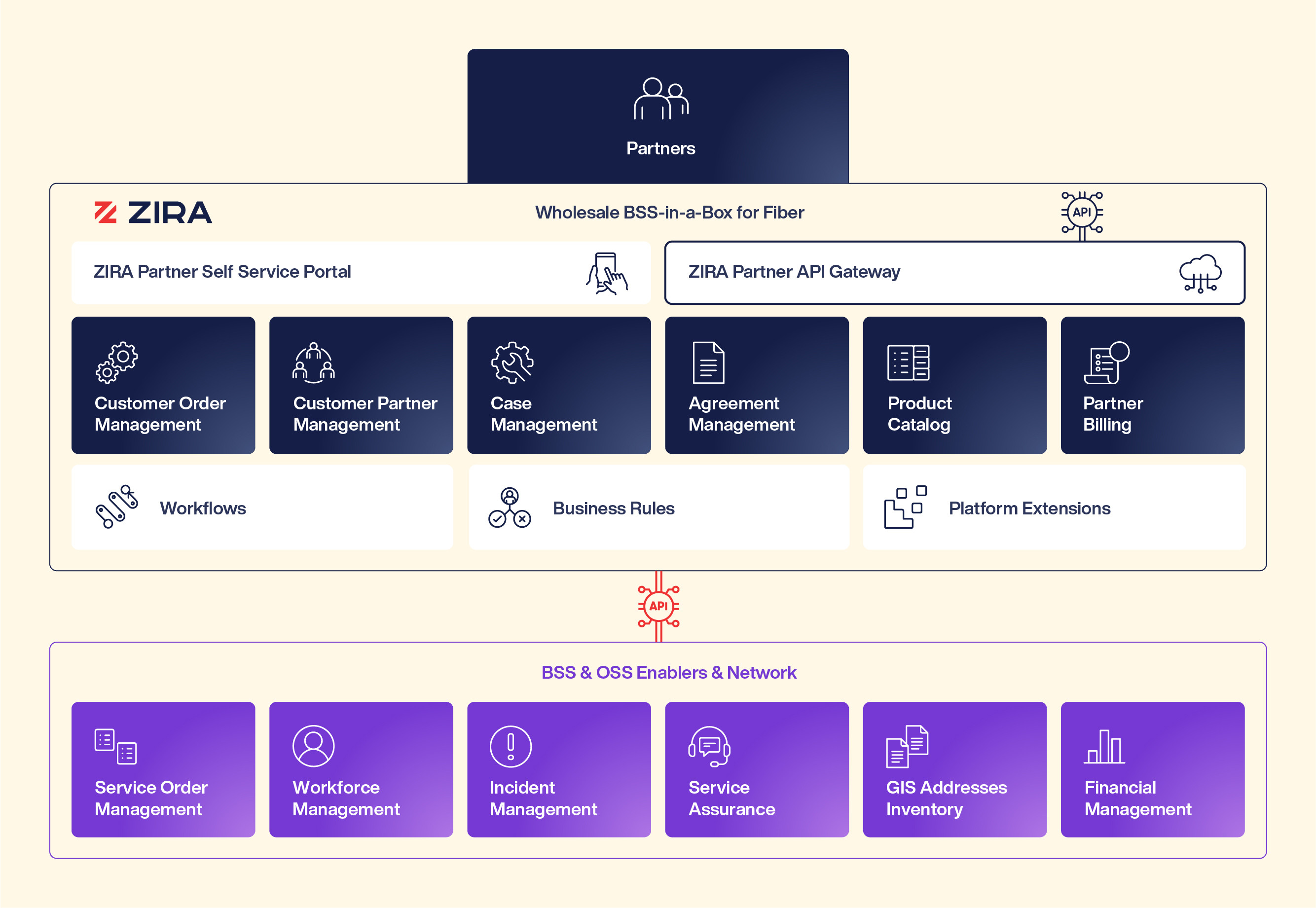
The scope covered the BSS Lead-to-Cash lifecycle, including product catalogue, partner and agreement management, order capture, service fulfilment, trouble ticketing and billing.
Wholesale partners could interact through a customized self-service portal or connect directly through TM Forum standard APIs.
The new wholesale environment also had to work with the wider IT landscape. ZIRA integrated it with external applications for workforce management, service fulfillment, GIS, and incident management. An extension framework provides flexibility for partner-specific processes and VMIE's operational requirements.
From implementation scope to operational readiness
The project reached its first technical go-live within one year. The implementation included more than 10,000 tested use cases across key business areas, supported more than 50 end-to-end digital use cases, and involved more than 10 TM Forum Open APIs. VMIE also secured wholesale agreements with multiple national RSPs, with further agreements in the pipeline at the time of ZIRA’s published case study.
10,000+ tested use cases across key business areas
50+ digital use cases supported end-to-end
10+ TM Forum Open APIs
These milestones reflect the scope and progress of VMIE’s specific transformation. They are not a universal implementation benchmark, nor do they establish the financial return attributable to the BSS project. However, what the implementation actually illustrates is more fundamental: wholesale readiness requires commercial processes, partner access, service management, and operational integrations to work together. At the end of the day, the network transformation and the business systems supporting it cannot be treated as unrelated decisions.
Before opening the network, define how businesses will work
For retail operators considering wholesale, the architecture discussion should follow a more fundamental set of business decisions. Which wholesale products they offer? How will commercial agreements determine partner eligibility and charging? How will RSPs interact with your systems? Who will own each stage of fulfillment and service management? How will you maintain reliable records of what was ordered, delivered, and billed?
These questions determine which capabilities can be reused, which need to be extended, and where a dedicated wholesale environment may be justified. They also influence how easily the business can accommodate new partners, introduce additional services, and manage increasing operational complexity.
The opportunity in wholesale broadband isn't simply to put more traffic over an existing network. It's to create a commercial model in which other service providers can reliably build their businesses on your infrastructure. Your network makes wholesale connectivity possible. Your business systems make it commercially workable.
Building a wholesale business?
Start with the right foundation.
From partner onboarding and product management to order orchestration, service fulfillment, and billing, ZIRA helps operators build the commercial and operational capabilities behind wholesale fiber.
Explore how ZIRA supported Virgin Media Ireland's wholesale transformation or talk to our team about your own wholesale BSS requirements.