Blog
Fiber Enablement
Order Management
Open API
Operational efficiency


Rigas Parathyras
Product Director
The order is accepted. The systems are responding. Every team has done its part. Yet the service isn't live, or worse, it's live but not being billed correctly. Welcome to one of wholesale fiber's most overlooked operational challenges.
A wholesale fiber order doesn't travel through one system. It moves across commercial, technical, and operational environments, each responsible for a different part of the service lifecycle. And while every application may process its own tasks correctly, that doesn't necessarily mean the original order has been delivered as intended. The problem isn't always that systems can't communicate. Sometimes they communicate perfectly well but disagree on what the information means, what needs to happen next, or whether the work is actually complete.
Individual system success doesn’t guarantee end-to-end order success. In our previous blog “What changes when a retail broadband operator becomes a wholesale provider?” we explored why opening a network to wholesale partners requires more than connectivity. Now comes the next question: what happens when that business has to execute a real order?
A wholesale fiber order is a chain of commitments
Let’s consider an illustrative wholesale fiber order.
A retail service provider (RSP) requests connectivity for three business locations under an agreed wholesale contract. The commercial offer includes specific bandwidth, installation requirements, service-level commitments, and recurring charges. So, let’s say that the order is accepted, but the three locations aren’t equal. One is immediately serviceable, another one requires an engineering check, and the third one depends on additional network construction. This doesn’t automatically mean anything has gone wrong. Different locations can legitimately require different fulfilment paths. But the real challenge lays in what happens next.
The product catalog must preserve the agreed configuration. Orchestration must translate the order into the appropriate delivery activities. Operational systems must track each site's progress. Activation must establish which services are ready. Billing must apply the agreed charges to the correct services and dates. All three sites belong to one commercial order, but they may progress through different operational states. If those relationships aren't maintained, the operator can lose sight of what was ordered, what has been delivered, and what remains outstanding. And that's when a valid commercial order can become an operational headache.
Where good orders go wrong
Not every delay is a system failure. But certain transitions introduce risks that operators need to understand and control.
1. The network can deliver It. But can the partner buy it?
We need to look at serviceability and commercial eligibility as a different questions. A location may be technically serviceable but unavailable to a particular partner under its agreement. Equally, a commercially valid product may not be deliverable at the requested address because of capacity constraints or network-build requirements. If qualification relies on outdated network information or incomplete commercial rules, the operator risks making a commitment that needs to be revised later.
That’s why service qualification must align with product eligibility before the order progresses.. TM Forum addresses these as distinct functions through its Service Qualification API (TMF645) and Product Offering Qualification API (TMF679). The most important principle is simple: A valid offer needs both commercial permission and technical feasibility.
2. The order is accepted, but did everything agreed survive?
Once a quote becomes an order, the details truly matter (e.g., bandwidth, access type, site references, resilience requirements, SLA, contract duration, discounts, recurring/non-recurring charges…etc.). All of those aren’t just fields in database anymore. Now, they define what the network owner has committed to deliver.
If an order moves downstream without the correct product version, configuration, or commercial conditions especially in multi-site scenario, and their team or system may be left to interpret what was originally agreed. The result can be rework, incorrect fulfilment instructions, or billing discrepancies. Moving an order forward means little if its original intent doesn’t move with it.
3. The tasks are completed, however is the service?
Order orchestration translates a commercial request into operational work. That can mean service orders, resource reservations, engineering checks, appointments, construction activities, and provisioning tasks. But task completion and service completion are not interchangeable. A field visit may be completed while technical acceptance is still pending. Provisioning may be finished for one site while another remains dependent on network construction. These are different states, with different implications for the partner. The operator needs to know which activities have finished, which dependencies remain open, and what evidence is required before the service can legitimately progress. Without consistent identifiers, agreed status definitions, and clear ownership, the operator may have plenty of task-level information but no reliable picture of the complete order.
4. The service is live, does the billing know?
Activation is a major operational milestone, but it isn’t necessarily the final commercial milestone. Billing needs to know which service became activate for which partner, at which location, and from what effective date.It must also apply the correct agreement, monthly recurring charges(MRC), non-recurring charges (NRC),discounts, proration, and any applicable credits. If service inventory, activation evidence, and commercial records disagree, the operator may face delayed charges, invoice corrections, or reconciliation work. The billing start date also needs to follow the applicable commercial agreement. Technical activation doesn't automatically establish that every charge becomes due immediately.
Why Open APIs are necessary, but not sufficient
A live service is only part of the story. The commercial record must explain what can be billed, when, and why.Connected Systems Are Not the Same as a Connected Process. This is where the conversation often turns to Open APIs. And for good reason. Standardized interfaces and information models help operators exchange data across BSS, OSS, partner systems, and network environments. They support interoperability and reduce the need to reinvent every integration, but a technically successful API exchange is not proof that an end-to-end business process has succeeded. Imagine a provisioning application sending a completed status to an order-management system. The message arrives, and the interface works, but what does “completed” mean?
Has the field activity finished, or service passed testing? Has the partner accepted delivery? Service reached the contractual milestone that permits billing? All of those distinctions cannot be resolved by message delivery alone. The require agreed business rules, consistent data definitions, explicit lifecycle updates, and clear responsibility for each decision. APIs connect systems, and the operating model determines whether those connections produce the right business outcome.
Five data groups with one connected journey
Keep key information consistent across every handoff, from quote-to-cash. Product/catalog version, service characteristics, partner eligibility, price and discount rules.
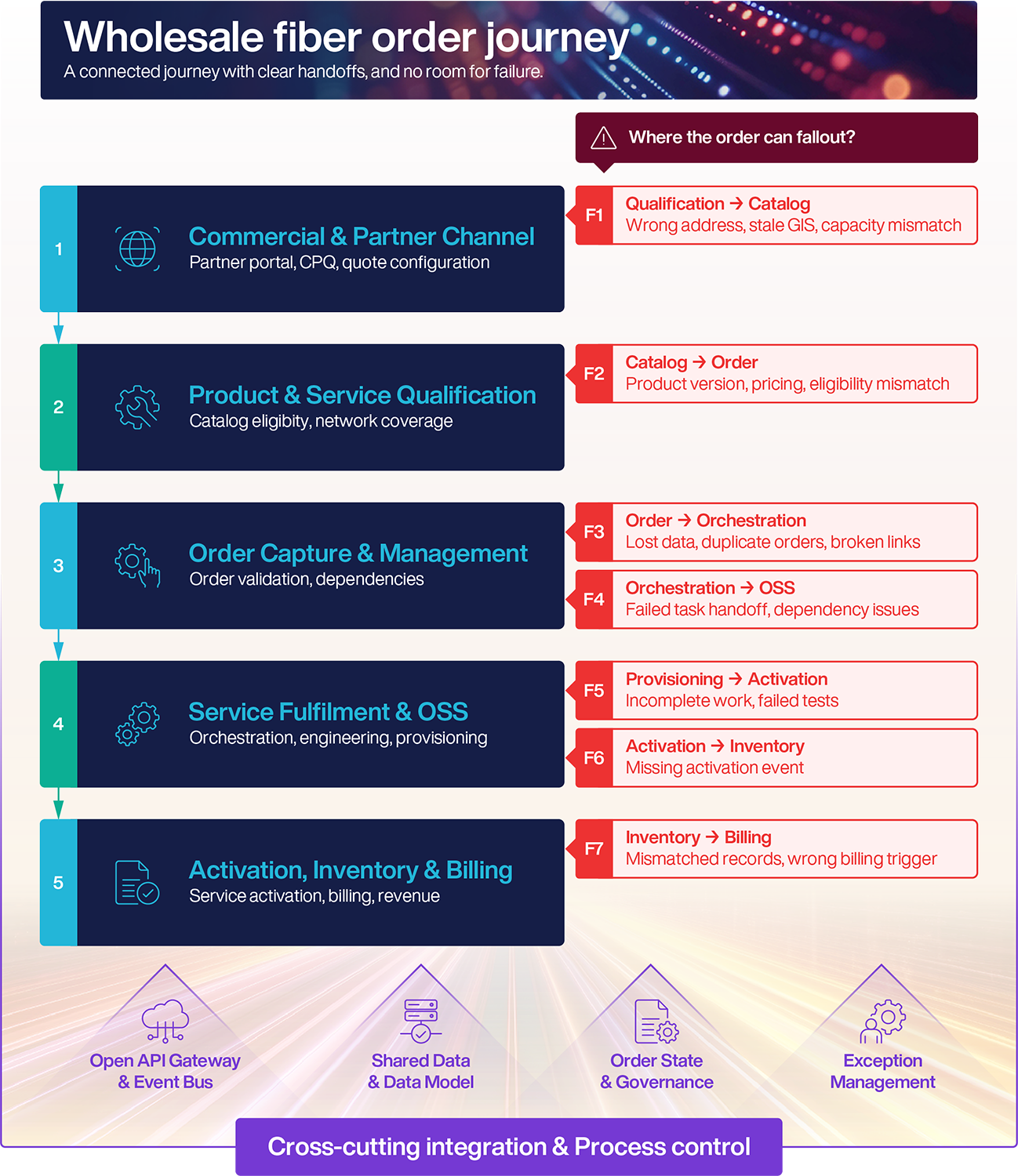
End-to-end visibility enabling greater business value. A consistent order journey helps telcos reduce order fallout, improve operational efficiency and unlock new growth opportunities.
Seven fallout points represent the most important control gaps to investigate
| Fallout point | What can go wrong | Business consequence |
|---|---|---|
| F1 - Qualification | GIS and catalog disagree about serviceability | Invalid quotes and rework |
| F2 - Catalog/order | Product configuration or commercial terms are lost | Incorrect orders and pricing |
| F3 - Order/orchestration | Incomplete data, broken dependencies or duplicate orders | Order fallout |
| F4 - Orchestration/OSS | Tasks or status updates fail to propagate | Provisioning delays |
| F5 - Provisioning / activation | Network work is incomplete or acceptance evidence is missing | Delayed or partial activation |
| F6 - Activation/inventory | Active network service is not correctly recorded | Poor service visibility |
| F7 - Inventory/billing | Activation and billing records do not match | Revenue leakage and invoice disputes |
Measure the handoffs, not just the applications
Baseline first time right qualification, fallout by handoff, manual touches per order, time in each status, reopened tasks, activation-to-billing latency and mismatches between activated services, inventory and invoices. Segment by partner, product, order type, geography and new-build requirement. Qualification fallout points to location or network data; billing discrepancies may reveal gaps in activation events or commercial rules. Replacing the whole stack may not be the best first move.
Four capabilities are particularly important:
- Consistent data: Shared identifiers and agreed data definitions across systems.
- Status synchronization: Every system understands what accepted, in progress, completed, rejected and activated actually mean.
- Exception ownership: Every failed handoff has an accountable owner, visible status and defined recovery process.
- End-to-end traceability: Operators can follow one order from the original quote through every fulfilment task to the first invoice.
What this looks like in practice: Virgin Media Ireland (VMIE)
When Virgin Media Ireland (VMIE) prepared to introduce wholesale fiber services, it needed an IT environment capable of supporting the commercial and operational requirements of its new business model, and they have chosen a dedicated wholesale IT stack.
ZIRA implemented its All-in-One fiber BSS platform, supporting the BSS Lead-to-Cash lifecycle across product catalog, partner and agreement management, order capture, service fulfilment, trouble ticketing, and billing. The implementation included partner self-service and API gateway capabilities, alongside integration with external systems for workforce management, geographical information systems (GIS), service fulfilment, and incident management. The project achieved its first technical go-live within one year. Its documented scope included more than 10,000 use cases tested, over 50 digital use cases supported end to end, and more than 10 TM Forum Open APIs. These figures demonstrate the implementation and testing scope, not a measured reduction in order fallout. What the project illustrates is the importance of connecting wholesale commercial capabilities with the operational environments responsible for service delivery. Because the wholesale order journey doesn't end at the boundary of any one application.

Other ZIRA engagements show related challenges. Sunrise is described as overcoming legacy constraints to accelerate service launches and time to market. Separately, stc Bahrain modernized wholesale trading, routing, rating and interconnect billing with ZIRA, strengthening operational visibility and financial control. These are not fiber-order metric, they show why operational and commercial processes must connect. ZIRA’s client references and stc Bahrain case study provide further context.
Before you replace a system, follow an order
When wholesale orders repeatedly stall, replacing the application where the problem becomes visible can seem like the obvious answer, however it may also be the wrong starting point. Let’s take one representative complex order and trace it from initial qualification through quote, capture, fulfilment, activation to the first invoice. What was agreed? What information entered each system? Which decisions were made? What evidence supported each status change? And where, if anywhere, did the technical or commercial understanding of that order change?
The answers can reveal whether the real issue lies in data quality, business rules, orchestration, integration, operational ownership, or a legitimate delivery dependency. They can also help determine whether an existing process needs to be corrected, an integration improved, or a broader architectural change is justified.Because a wholesale order isn't successful simply because every system has done something with it. It's successful when the business can prove that what was sold, what was delivered, and what was billed still match.
Make every order count
ZIRA helps wholesale operators connect partner management, product catalog, order orchestration, fulfilment, and billing across complex BSS/OSS environments. Explore ZIRA's wholesale fiber capabilities and see how the right commercial and operational foundations support a more connected order journey.
Explore ZIRA's Wholesale Fiber Solutions
ZIRA’s All-in-One Wholesale BSS for fiber gives you everything you need to launch and manage fiber successfully, maximizing revenue from your infrastructure.